E-bikes Between Spark and Flame: How to Prevent Lithium-Ion Battery
- Nov 17, 2025
- 5 min read
Updated: Dec 14, 2025
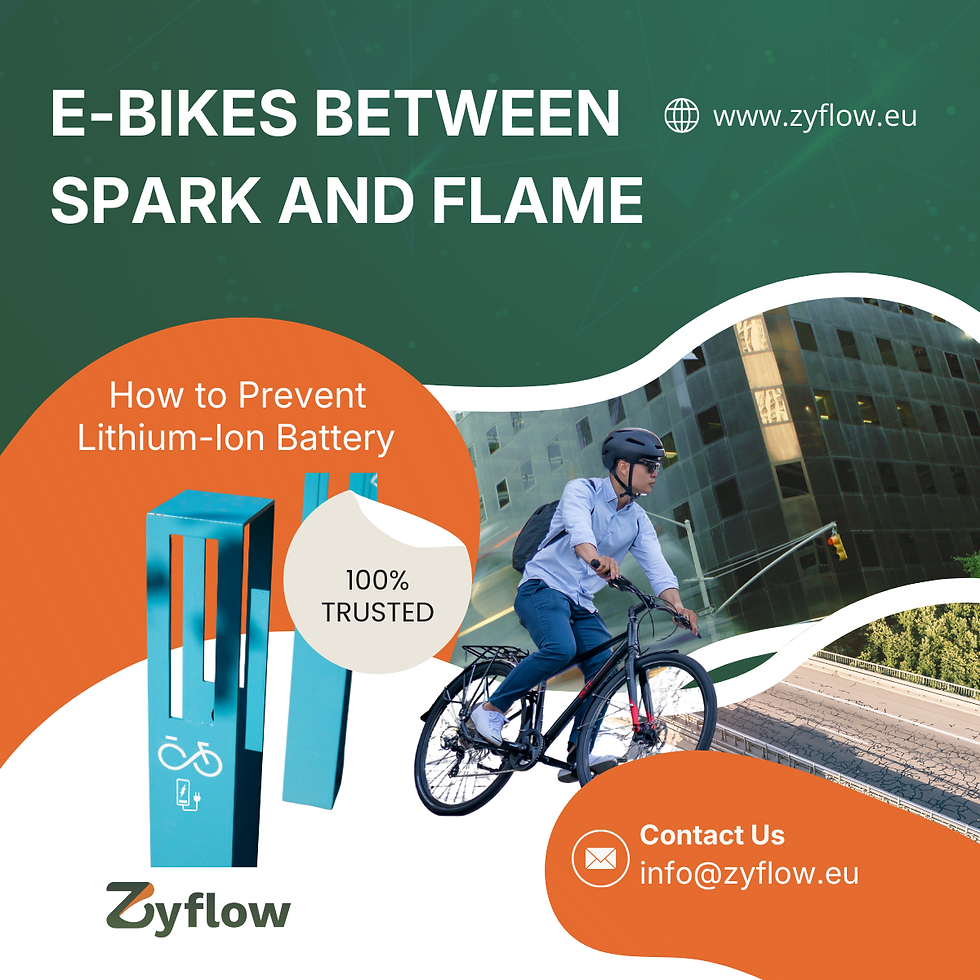
Zyflow Vision: Building a Safer, Smarter E-Bike Ecosystem
At Zyflow, we believe every e-cyclist deserves clear, reliable, and practical information — whether they are charging their battery, planning a route, or navigating the growing landscape of e-bike infrastructure.
Our team is building a comprehensive digital ecosystem that brings together fragmented data and expert knowledge. Our mission is simple:to make e-biking safer, more accessible, and more enjoyable for everyday riders, tourists, and long-distance explorers.
We aim to support not only e-bike users but also the creators of e-bike friendly infrastructure — municipalities, tourism destinations, hardware manufacturers, engineers, and innovators shaping the future of electric mobility. By bridging user needs with technical expertise, Zyflow contributes to a more transparent, safer and well-designed e-bike environment across Europe and beyond.
Article Overview
This article explores:
Why e-bike fires are becoming a global safety issue;
Real-life examples of battery fire incidents;
The most common causes of fires and explosions;
Safety recommendations for users, local communities, and tourism destinations;
What an ideal safe-charging ecosystem for e-bikes could look like.
E-bike Fires – The Dark Side of Electrified Mobility
The rapid adoption of e-bikes has transformed urban transport and tourism, offering clean, quiet, and efficient travel.
However, the safety standards for batteries and chargers have not kept pace with this growth.
Lithium-ion batteries are powerful but can become unstable and explosive when damaged, modified, or charged incorrectly.
Global Fire Incidents
United Kingdom (2024): The Guardian reported over 211 e-bike and e-scooter fires in the first half of 2024 – the highest number ever recorded.
New York City (2023): According to Associated Press, battery fires caused 22 residential blazes and 2 deaths in a single year.
Australia (2025): The Daily Telegraph covered 14 lithium-ion fires in just nine days, caused by homemade charging setups.
Germany (2024): The Institute for Fire Safety Research (IFAB) documented a multi-battery chain fire in a parking hall — flames reached over 600°C in under ten seconds.
Common pattern: unapproved batteries, cheap chargers, and overnight indoor charging.
Frequency and Trends
The number of e-bike battery fires continues to climb sharply.
Source / Year | Number of Fires | Region | Key Insight |
OPSS, 2024 | 211 | United Kingdom | 9 out of 10 fires occurred indoors |
ETA & London Fire Brigade, 2024 | +60% | UK | Most linked to counterfeit batteries |
AP News, 2023 | 22 | USA | 2 fatalities |
IFAB, 2024 | 100+ tests | EU | Chain fires and toxic gas release |
BRE Group, 2024 | 50+ tests | EU | Overheating and short-circuit ignition |
Trend: Fire incidents are rising each year, especially in urban areas and tourist accommodations where e-bikes are charged indoors or in confined garages.
Main Causes of E-bike Battery Fires
Non-certified or Counterfeit Batteries
The leading cause across all studies. Batteries sold without CE or UN38.3 certification often lack voltage control and thermal protection, making them highly unstable.
Unsafe Chargers
Low-cost chargers without Battery Management Systems (BMS) fail to stop charging once full, leading to thermal runaway — an uncontrollable chain reaction of overheating.
DIY or Modified Battery Packs
Users modify or replace cells to increase range, removing the safety circuitry in the process. According to the Fire Protection Association (FPA, 2025), 18% of e-bike fires involved modified batteries.
Overheating and Moisture
Heat or humidity causes short circuits and electrolyte degradation. Fires can start spontaneously without external damage.
Unattended Charging
ETA (2024) reports that 90% of e-bike battery fires occur at night, often while users are asleep. Fires escalate extremely fast — temperatures can exceed 600°C within seconds.

(Infographic: Main Causes of Fires)
Safety Recommendations for E-bike Users
Always use original, certified batteries and chargers from reputable brands (Bosch, Shimano, Brose…).
Charge only on non-flammable surfaces – concrete, tiles, or metal.
Never charge overnight or without supervision.
Inspect batteries regularly – discard swollen, rusty, or damaged units immediately.
Avoid heat and moisture exposure.
Store batteries separately at 30–60% charge when not in use.
Never modify electrical components or connect incompatible parts.

Infographic: Safety Recommendations for E-bike Users
Recommendations for Municipalities and Tourism Destinations
Establish Safe Charging Zones
Outdoor or semi-enclosed charging points with fire sensors, ventilation, and automatic shutoff mechanisms — essential for hotels, hostels, camps, and mountain lodges.
Certify “E-bike Friendly” Accommodations
Tourist facilities offering secure parking, certified charging points, and basic repair kits should be recognized as safe e-bike hubs.
Local Regulations for E-bike Charging
Municipalities should define minimum technical standards for installing and maintaining public and private charging stations.
Educate Users and Operators
Tourism boards and local communities should lead awareness campaigns about safe charging, handling, and battery disposal.
Support Smart-Charging Innovation
Encourage the development of “smart-safe” charging systems with heat sensors, automatic cutoffs, and real-time monitoring apps.
Create Battery Collection Points
Introduce “Battery Drop Stations” in tourist centers and bike rental shops for recycling or safe disposal of old batteries.
What a Safe E-bike Charging System Should Look Like
A truly safe e-bike infrastructure should include:
Standardized battery connectors and certified components (EU “SafeCharge” label);
Smart, temperature-controlled outdoor charging hubs;
Real-time thermal and humidity sensors;
Mobile apps for safety alerts and maintenance tracking;
Emergency assistance for stranded or overheated e-bikes;
Centralized certification databases for traceability and transparency.
Such a system could reduce fire risk by over 90% (FPA & ETA, 2024).

Infographic: What a Safe E-bike Charging System Should Look Like
Conclusion
Battery safety is not just a technical issue — it’s a public and infrastructural responsibility.
E-bike battery fires are a consequence of rapid electrification without aligned safety frameworks.
If we want e-mobility to remain the symbol of sustainability, it must also become the symbol of safety and trust.
Through standardization, certified infrastructure, and user education, we can prevent tragedies and strengthen confidence in the electric future of cycling.

Call to Action for Engineers, Innovators & Technical Experts
If you work in any of the following fields:
charging station development
battery systems & BMS safety
IoT solutions for smart charging
fire safety, thermal monitoring or testing
infrastructure design and mobility planning
technical standards, certification or compliance
data analytics for e-bike usage and tourism flows
…we would love to connect with you.
Share your knowledge, insights, or new solutions with us.Your expertise can help shape a safer, smarter infrastructure for millions of e-bike users — from daily commuters to international cycle tourists.
At Zyflow, we are building an open, collaborative platform. Every contribution helps bring the e-bike world one step closer to safety, innovation, and true rider confidence.
Sources
ETA (Environmental Transport Association): E-bike Battery Safety – Research & Advice, 2024
IFAB (Institute for Fire Safety Research): E-bike Fire Safety, 2024
FPA & OPSS: E-bike Battery Research Report, 2025
BRE Group: E-scooter and E-bike Lithium-ion Battery Fires, 2024
FSRI / Underwriters Laboratories: Addressing the Risk of Electrical Shock and Fire from E-bikes, 2022
The Guardian (2025): Record Number of E-bike Fires in the UK
Associated Press (2023): E-bike Batteries Blamed for 22 NYC Fires, 2 Deaths
Daily Telegraph (2025): Homemade Charging Setup Sparks 14th Battery Fire in Nine Days


Comments